Electronic HOA voting in Colorado
Colorado's association voting rules combine CCIOA, governing documents and, for incorporated associations, the Nonprofit Corporation Act. CCIOA requires secret ballots for contested board elections rather than setting a dedicated online-voting procedure. Check written-ballot, meeting, proxy and notice rules with your association's attorney before choosing an electronic method or assuming it counts toward quorum.
The Colorado electronic HOA voting guide on this page is general legal information, not legal advice. Statutes change and your governing documents add their own requirements; confirm specifics with your association's attorney before changing how you vote.
The short answer
Colorado is an outlier: CCIOA, the Common Interest Ownership Act, has no dedicated electronic voting statute for associations. What it does require is that votes for contested board seats be taken by secret ballot (section 38-33.3-310), and it encourages electronic delivery of notices (section 38-33.3-308). The working legal footing comes from the Colorado Revised Nonprofit Corporation Act, which most associations are organized under: action by written ballot without a meeting (7-127-109), participation in meetings by telecommunication with full presence for quorum (7-127-108), and electronically transmitted proxies (7-127-203).
What the statute actually says
Colo. Rev. Stat. 38-33.3-310 (CCIOA, Voting; proxies) (HOA / condo / planned community / co-op)
"Votes for contested positions on the executive board shall be taken by secret ballot."
Read the full section at the official legislature site
Governs association voting and proxies. Contains NO electronic-voting authorization; verified against the full official 2025 text. It mandates secret ballots for contested board elections, neutral counting, anonymized results, and proxy voting per 7-127-203.
Colo. Rev. Stat. 38-33.3-308 (CCIOA, Meetings) (HOA / condo / planned community / co-op)
"The association is encouraged to provide all notices and agendas required by this article in electronic form, by posting on a website or otherwise, in addition to printed form."
Read the full section at the official legislature site
Electronic NOTICE only, not electronic voting or remote participation. Associations may post notices electronically and must email meeting notice to owners who request it; the section says nothing about casting votes electronically.
Colo. Rev. Stat. 7-127-109 (Colorado Revised Nonprofit Corporation Act, Action by written ballot) (Associations organized as Colorado nonprofit corporations)
"any action that may be taken at any annual, regular, or special meeting of members may be taken without a meeting if the nonprofit corporation delivers a written ballot to every member entitled to vote on the matter"
Read the full section at the official legislature site
The mechanism Colorado associations organized as nonprofit corporations use to vote by ballot without a meeting. The statute is silent on delivery medium; it does not expressly authorize (or forbid) electronic ballots.
Colo. Rev. Stat. 7-127-108 (Colorado Revised Nonprofit Corporation Act, Meetings by telecommunication) (Associations organized as Colorado nonprofit corporations)
"A member participating in a meeting by this means is deemed to be present in person at the meeting."
Read the full section at the official legislature site
Virtual or telephonic member meetings: any or all members may participate through any means of communication by which all participants can hear each other, so members can attend and vote at a remote meeting.
Colo. Rev. Stat. 7-127-203(2)(b) (Colorado Revised Nonprofit Corporation Act, Proxies) (Associations organized as Colorado nonprofit corporations)
"A member may appoint a proxy by transmitting or authorizing the transmission of a telegram, teletype, or other electronic transmission providing a written statement of the appointment to the proxy"
Read the full section at the official legislature site
Electronic transmission of proxy appointments. This is the one member-voting-adjacent provision in the acts reviewed that expressly names electronic transmission; CCIOA 38-33.3-310(2)(a) points proxy mechanics at this section.
The conditions that matter
- No electronic-voting language anywhere in the section (or anywhere in CCIOA Art. 38-33.3)
- Contested executive-board elections must be by secret ballot (38-33.3-310(1)(b)(I)(A))
- Ballots counted by a neutral third party or a committee of non-board, non-candidate volunteer owners
- Results reported without names, addresses, or other identifying information of voting owners
- Board discretion or 20% of owners present/represented at a quorate meeting can require secret ballot on any all-owner vote
- Proxies must be dated, are revocable by actual notice, and terminate after eleven months unless an earlier date is stated
- Last amended 2022 (SB 22-059, subsection (2)(b)); no 2023-2026 amendment
- Email notice only to unit owners who request it and furnish their email address (38-33.3-308(2)(b)(I))
Recent changes
None found affecting electronic voting, 2024-2026. The source notes in the 2025 Colorado Revised Statutes show 38-33.3-310 was last amended by SB 22-059 (2022, the proxy subsection (2)(b)) and 38-33.3-308 by HB 22-1137 (2022, the executive session subsection (4)(e)).
Running a vote that meets the bar
So electronic voting in Colorado is a governing-documents question rather than a statutory one: if your bylaws permit action by written ballot or the board adopts the right procedures under the Nonprofit Corporation Act, an online vote can satisfy them, and the CCIOA secret ballot requirement for contested board seats still applies. In One Group Central, every ballot is stored encrypted, the board sees only the final counts once an admin closes the vote, and each voter gets a receipt in the app. In a contested seat with very few voters, those counts can still reveal a choice. That keeps ballots out of the board's sight but not out of ours: we receive each ballot, along with who cast it, before encrypting it, so we do not claim the system is secret from the operator.
Frequently asked questions
Does Colorado have an HOA electronic voting statute?
No. CCIOA has no dedicated electronic voting section. Associations rely on their governing documents plus the Colorado Revised Nonprofit Corporation Act, including action by written ballot under 7-127-109 and meeting participation by telecommunication under 7-127-108. Other states went the other way and named the permitted delivery methods in the statute itself, which is the footing behind Arizona HOA electronic voting.
Are secret ballots required in Colorado?
For contested board seats, yes. CCIOA section 38-33.3-310 requires votes for contested positions on the executive board to be taken by secret ballot. California spells out more of the process after the vote: California Civil Code 5125 keeps the sealed ballots and the tally sheet of an electronic secret ballot in the custody of the inspector of elections until the challenge period runs out.
So is online voting legal for Colorado HOAs?
Generally yes in practice, through the nonprofit corporation provisions and your governing documents, but because no dedicated statute says so, reviewing your bylaws with your association's attorney matters more in Colorado than in states with express statutory authorization, like the rules for Nevada HOA electronic voting.
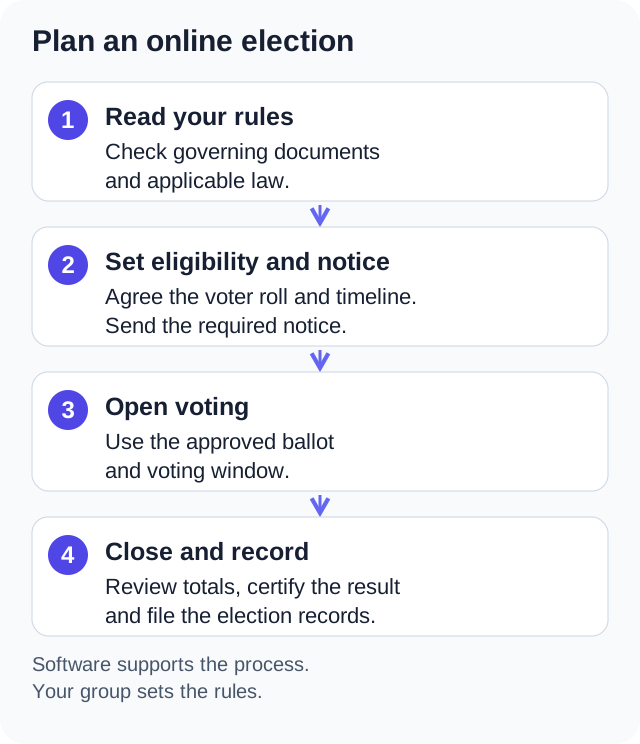
Run your next contested board election online
One Group Central tallies the race when an admin closes it, keeps every ballot encrypted, and shows each voter a receipt, with your documents and announcements in the same place.
Start your free 60 day trialFree for 60 days with up to 25 people. No credit card.