Robert's Rules and electronic voting
Robert's Rules does not turn a video meeting, a ballot during that meeting and a vote outside a meeting into the same procedure. Check your applicable law and governing rules, identify which action is proposed, and record the authority before voting.
A video meeting, an email consent and an online ballot left open for a week are different procedures. Identify which one you are proposing before asking whether Robert's Rules permits it. This guide is general information, not legal advice; a qualified adviser should resolve the rules for your body and jurisdiction.
Why I wanted both ways to vote
I built One Group Central's ballot feature with both settings in mind: members voting during a meeting, and members voting separately before a deadline. I wanted to make cheating or fraud harder.
That is a design goal. An organization still has to check who may vote, which procedure its rules permit and whether the app can supply the records that procedure requires. The app limits below are part of that decision.
Three procedures with different checks
| Proposed action | Question to resolve | What not to assume |
|---|---|---|
| A live phone or video meeting | What authorizes this body to meet electronically, and how will members participate, establish quorum and vote? | A calendar invitation or video account is not the governing authority. |
| An electronic ballot during that meeting | Does the authorized meeting procedure allow the voting method, preserve members' rights and meet any ballot requirements? | An electronic button used during a meeting is not automatically the same as an absentee ballot. |
| A ballot or email decision outside a meeting | What law or governing provision specifically permits action without that meeting, and under which conditions? | Permission to meet on video does not by itself let absent members vote later. |
The Robert's Rules authors' sample electronic-meeting rules describe authorization and procedures for live meetings, including scenarios with electronic secret ballots. They are sample rules to adapt, not blanket permission for a week-long asynchronous vote. The document was prepared in 2020 with references to the 11th edition; use the edition and rules your organization actually adopted.
An electronic ballot also differs from a proxy: the member submits the ballot, while a proxy authorizes someone else to act for that member. The authors' proxy FAQ points to the applicable law or bylaws for that separate authority. Do not treat an online ballot as a substitute for proxy procedures.
A statute may supply a different route
The authors' official FAQ says its rules are defaults subject to applicable law and the organization's own provisions. Read those first.
For example, New York N-PCL 708 distinguishes simultaneous board participation from board action without a meeting. Unless restricted by the certificate or bylaws, it allows the latter when every board or committee member consents to the resolution, with the consent records filed with the minutes. Its remote-meeting provision requires members to hear each other simultaneously and participate in the matters before the body.
This is a New York not-for-profit board/committee example. It is not authorization for every nonprofit membership vote, HOA election or union ballot. An ordinary majority email poll is not the same procedure as the statute's all-member consent. Ask counsel which provisions govern your entity and action.
N-PCL 708, the official FAQs and the authors' sample rules checked . These sources do not certify a product or determine your organization's authority.
Write down the authority and the operating rule
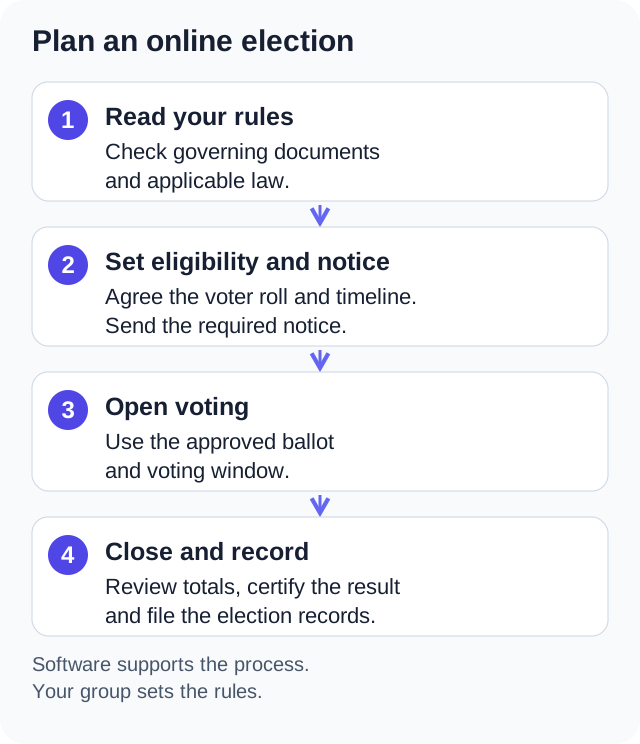
Before a meeting or ballot is announced, give the chair and secretary a short procedure that names:
- The body making the decision and the law, bylaw or adopted rule authorizing this method.
- Who receives notice, by what permitted channel and how long before the action.
- How eligibility, remote attendance, quorum and the approval threshold will be established.
- How members ask questions, propose changes and exercise the rights the procedure requires.
- How a ballot is kept private when required, who reports the result and which evidence is retained.
- What happens if someone cannot connect or the meeting/ballot system fails.
If a change to the bylaws is needed, use the amendment procedure before relying on the proposed new authority. Installing software cannot make that change for you.
Check the roster and record limits before opening a portal ballot
One Group Central does not freeze the eligible roster for you. A new member accepting an invitation while an election is draft, scheduled or open can be added when they qualify for its audience and permissions. Account status and permissions can also affect whether an existing member may vote. If your rules require a fixed list, settle that process with the organizers and preserve its record before opening the ballot; do not assume the app enforces a cutoff.
Keep the roster and required recipient evidence under the organization's control. The app's aggregate counts are not an individual turnout list. Announcements also depend on audience, sending settings and delivery services; a send event does not establish that every required notice arrived.
The service receives a member's identity and choices before it encrypts a ballot. Admin screens show aggregate results, but the operator could link choices to people. A receipt compares a saved entry and position with the server record, not with an independently recomputed tally. Successful tally removes the live private key, so the app cannot decrypt those ballots again for a recount. Earlier database backups may retain the old key until they expire; live-key deletion does not establish that every historical copy is gone. Read the privacy and verification limits before choosing it for your procedure.
If the email vote has already happened
Preserve the messages, the proposed action and whatever result was announced. Identify the governing provision before labeling the action valid or invalid. Ask the appropriate legal or parliamentary adviser whether a properly convened vote, ratification or another remedy is available. Do not assume a later entry in the minutes automatically cures a missing authority or notice requirement.
For the next decision, keep the relied-on authority, notice, permitted eligibility record, ballot wording and result with the minutes. Distinguish the record of an action from the conversation that preceded it.
Use this as a planning brief. A qualified adviser still needs to review the rules that apply to your organization.
Test the member workflow after settling the rules
Use One Group Central for documents, announcements and a practice ballot while your organization checks the procedure and evidence its actual decision requires.
Start your free trial